Book Club for Busy Moms: Reading for Our Lives by Maya Payne Smart
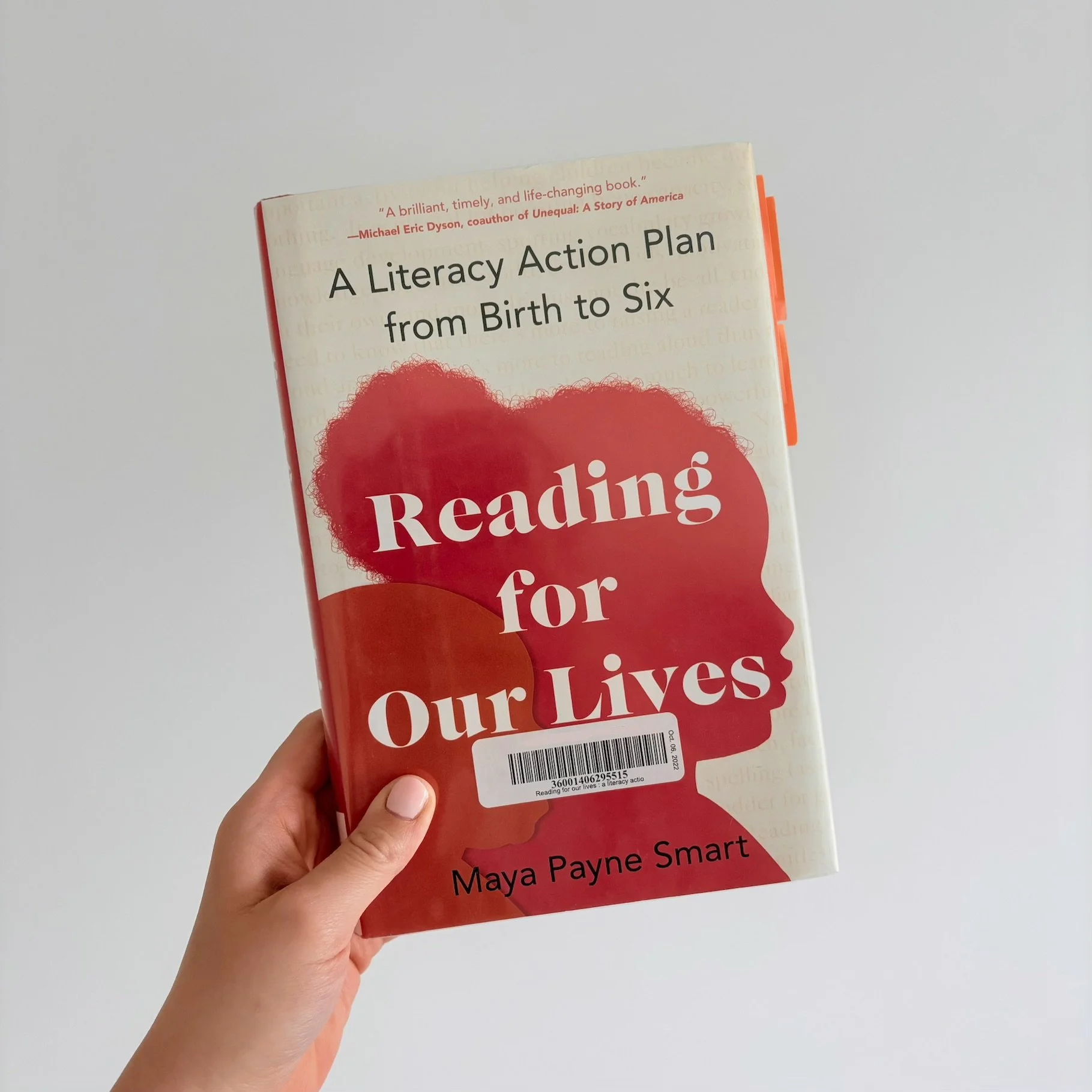
It’s very important to me as a parent to raise strong readers. Admittedly, I thought I was doing good enough with a big collection of picture books, storytime before bed, and regular trips to the library.
When we think about raising readers, most of us probably picture a similar set-up. And while reading aloud is absolutely important, Reading for Our Lives by Maya Payne Smart convinced me that raising a reader is so much bigger than storytime. This book discusses the idea that literacy development begins long before a child ever sounds out their first word.
What I appreciated most about this book as a busy mom is that it keeps early literacy from feeling like “one more thing I need to fit into the schedule” and simplifies it into small habits that can work with your regular daily activities with your kids. You don't need a complicated curriculum or hours of structured instruction. You can build literacy while you're making breakfast, driving in the car, playing on the floor, looking at a picture book, or talking about something your child is curious about. The book’s central message is both encouraging and challenging: if we want our children to become confident readers, we shouldn't wait until school starts to begin preparing them.
Main Takeaway #1: What Raising a Reader From Birth Looks Like
One of the biggest takeaways for me was realizing just how much literacy development is happening before a child can actually read. This book emphasizes that the early years are foundational because children's language experiences are helping build the skills and knowledge that later support reading. And this starts with something incredibly simple: talking to your baby. Narrating what you're doing, responding to their sounds, introducing new vocabulary, singing songs, playing back-and-forth games, pointing things out on walks, and having little “conversations” all count. This is where the idea that talking comes before reading becomes so important. A child needs to develop an understanding of language before they can eventually connect written words to meaning. Books are part of this too, but they don't have to look like formal reading lessons. Let your baby hold and explore books, point at pictures, name what you see, repeat words, make animal sounds, and talk about what is happening on the page. At this age, raising a reader isn't about teaching your baby to read. It's about building a child who is surrounded by language and who learns that words, pictures, books, and communication are interesting and meaningful.
Main Takeaway #2: Teaching Early Literacy Before School
The toddler years are where those everyday experiences can start becoming more intentional, but that doesn't mean sitting your child down for a worksheet every afternoon. I loved that Reading for Our Lives expanded the definition of what “reading practice” can look like. It encourages parents to incorporate literacy into ordinary life: talking about stories, asking questions, introducing letters and their sounds, noticing words and print around you, playing with rhymes, singing songs, and giving children opportunities to interact with books rather than simply listening to an adult read them. You can point out the first letter of your child's name, look for letters on signs while you're out, make up silly rhymes in the car, let your child “read” a familiar story from memory, or ask them what they think will happen next in a book. You can talk about the grocery list, read the name on a cereal box, look at a recipe together, or investigate an animal your child suddenly wants to know everything about. This was especially helpful for me as a busy mom because it takes away the idea that I need to find an extra hour in my day to “teach literacy.” I can build it into the things we're already doing. And perhaps most importantly, it reminds me that literacy isn't just about storybooks. It's speech. It's conversation. It's curiosity. It's play. It's listening. It's letters and sounds. It's learning new words. It's interacting with the written world around us.
Main Takeaway #3: Why Early Literacy is so Important
This is where the book's message becomes much bigger than simply wanting our children to enjoy books. Early language and literacy skills provide an important foundation for everything children will eventually be asked to do in school and beyond. We can’t just assume that kindergarten will be the starting line for literacy, because children arrive at school with very different levels of language, vocabulary, print knowledge, and other foundational skills. And once a child begins school behind, simply moving through the grades does not necessarily make the gap disappear. Early struggles can snowball without appropriate support, which is one reason this book makes such a strong case for parents being active participants in their children's literacy development. This is about recognizing that we are our children's first teachers. We shouldn't have to depend entirely on a teacher, preschool, or childcare provider to notice that a child is struggling or to know exactly how to support them. By paying attention to our children's language and literacy development from the beginning, we can notice potential difficulties earlier, seek help when we need it, and give our children a stronger foundation before they are expected to learn increasingly difficult material at school. And the benefits extend far beyond learning how to decode words. Reading opens the door to everything else: science, history, mathematics, art, geography, imagination, problem-solving, and the ability to learn independently. Teaching a child to read is ultimately giving them a tool they can use to teach themselves almost anything.
Quotes from the Book:
“Knowing firsthand how words nourish, I wanted to feed her page upon page, give her tastes of poetry, let her sip prose. […] Reading to her was love, care, and a pathway to a family ethos that I treasured.”
“Starting strong creates a chance at recovering from setbacks. So it goes with your child’s literacy: you will never find a better time than now to launch a reader.”
“Parents are often said to be kids’ first and best teachers. The “first” part is guaranteed, but the “best” part must be earned.”
“The central truth every parent must grasp is this: oral language skills are required for reading. Just as kids crawl before they walk, they talk before they read. And before they talk, babies listen, grunt, and coo. We must facilitate and encourage it all.”
“It’s impossible to teach your child everything they need to know to thrive in an unpredictable world. But when you focus on reading, you can rest assured that you’re building the skill that supports all others.”
Further Reading:
Reading for our Lives by Maya Payne Smart
The biggest thing I took away from this book is that raising a reader isn't something that begins when a child picks up a book and starts reading. It begins with the very first conversations we have with them. It begins when we answer their endless questions, introduce them to new words, sing songs, play games, look at books, point out letters, tell stories, and follow their curiosity. Talk in the grocery store. Make up rhymes in the car. Let your child play with magnetic letters. Read the sign at the park. Ask questions. Listen to their answers. Follow their interests. Read about the things they're fascinated by. Make books a normal part of life. The goal isn't to rush our children into reading before they're ready, it's to surround them with language and make the written world feel familiar, interesting, and accessible from the beginning. Because when we raise children who have the language to understand the world and the literacy skills to explore it, we're giving them more than the ability to read a book. We're giving them a lifelong way to learn.